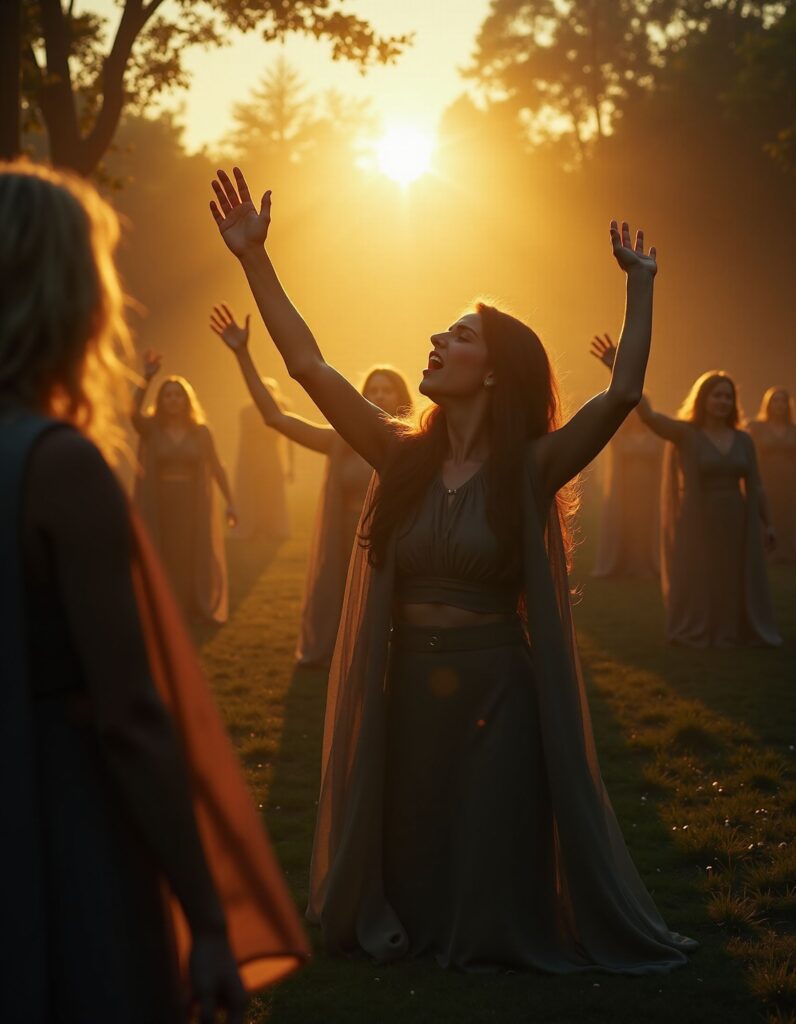
The question. "The world has been broken by years of corrupt politicians and power hungry leaders. Along with dwindling resources humanity has looked for a new healthier system of governance. Many years late we now have Druids offering spiritual and practical leadership. How can we integrate a system to prevent a single malicious person, or group from taking control. Show us how this type of society could work and could it be expanded worldwide?"
A Druidic system, by its nature, is rooted in interconnectedness, cyclical time, and reverence for the whole. To prevent tyranny, the system must embody these principles: "decentralization, distributed wisdom, and ecological accountability."
Here is a framework for how such a society could function, followed by an analysis of its global scalability.
---
Part I: The Structure of Druidic Governance (The Anti-Tyranny System)
The core principle of this system is "Distributed Sovereignty." No single person or council holds ultimate authority; power is a flow, not a reservoir.
1. The Pillars of Governance
Instead of a single government, the society is composed of three interlocking, mutually checking pillars:
A. The Circle of Lore (The Wisdom/Judicial Pillar)
"Function:" This body holds the historical memory, the ethical codes, and the ecological knowledge. They are the keepers of the *Way*—the foundational principles of the society.
"Composition:" Elders, specialized scholars (herbalists, astronomers, historians), and those who have demonstrated deep, long-term commitment to the community.
"Anti-Tyranny Mechanism:" They do not make policy; they interpret the *Way*. They ensure that any proposed action aligns with the long-term health of the ecosystem and the community's ethical standards. They act as the ultimate ethical check.
B. The Council of Seasons (The Executive/Practical Pillar)
"Function:" This body handles day-to-day logistics, resource allocation, and practical problem-solving (e.g., managing water rights, planning harvests, infrastructure maintenance).
"Composition:" Rotating representatives drawn from different geographical sectors, skill sets (farmers, builders, healers), and age groups. Terms are short and non-renewable.
"Anti-Tyranny Mechanism:" "Mandatory Rotation and Term Limits." No one can become a permanent executive. Their power is temporary and tied to the needs of the current season or cycle. They are accountable to the local communities they represent.
C. The Hearth Circles (The Local/Sovereign Pillar)
"Function:" These are the smallest, most fundamental units of governance—the villages, hamlets, or specialized guilds. They manage local resources, enforce local customs, and determine local needs.
"Composition:" All adult members of the community.
"Anti-Tyranny Mechanism:" "Local Autonomy and Veto Power." The Hearth Circles are the true sovereign units. They have the power to reject any policy or resource allocation proposed by the Council of Seasons if it negatively impacts their local environment or community. This prevents a central authority from imposing a harmful agenda.
2. Mechanisms of Accountability and Prevention
To prevent a malicious individual from gaining undue influence, the system employs several structural safeguards:
"The Principle of Distributed Knowledge:" No single person holds all the necessary information to control the system. Resource management data is held by the Hearth Circles; ethical precedents are held by the Circle of Lore; and logistical plans are held by the Council of Seasons. To seize control, a malicious actor would have to corrupt all three independent pillars simultaneously.
"The Oath of the Root:" All leaders (in all three pillars) take a public, binding oath that is not merely legal, but spiritual. This oath binds them to the health of the land and the well-being of the community. Violation of this oath is not a political crime; it is a spiritual and social exile, enforced by the collective judgment of the Hearth Circles.
"The Seasonal Review:" Every cycle (e.g., every year), the entire system undergoes a public review. The Hearth Circles audit the Council of Seasons, and the Council of Seasons must justify its actions to the Circle of Lore. This constant, cyclical scrutiny prevents complacency and the slow accumulation of unchecked power.
"The Role of the Mediator (The Neutral):" A specialized, non-political role exists—the Mediator. This individual is not a judge, but a facilitator. Their sole purpose is to ensure that communication between the three pillars remains honest and that conflicts are resolved through dialogue and ecological understanding, not force.
---
Part II: How the Society Works in Practice
Imagine a decision must be made: *Should the community divert a river tributary to irrigate a new, high-yield crop field?*
1. "The Hearth Circles (Local Input):" The downstream Hearth Circles raise immediate concerns: "This diversion will reduce the water flow to our sacred wetlands and impact the migratory fish." They hold the local veto.
2. "The Council of Seasons (Practical Proposal):" The Council of Seasons presents the proposal, detailing the economic benefits and the engineering plan. They must also present mitigation strategies (e.g., "We will only divert 20% of the flow").
3. "The Circle of Lore (Ethical Review):" The Circle of Lore reviews the proposal against the *Way*. They ask: "Does this action violate the principle of ecological balance? Does the short-term gain outweigh the long-term spiritual and environmental cost?"
4. "The Synthesis:" The Council of Seasons must then negotiate a compromise that satisfies the ethical constraints of the Lore and the environmental concerns of the Hearth Circles. If the compromise is reached, it is implemented. If not, the proposal dies.
"The result is a system of constant, decentralized negotiation, where power is always conditional and temporary."
---
Part III: Global Scalability and Challenges
Could this system be expanded worldwide? Yes, but only if the fundamental cultural and psychological shifts are embraced.
🌍 The Path to Global Expansion
1. "Modular Implementation (The Seed Model):" The system should not be imposed globally as a monolithic state. Instead, it must be implemented as self-sustaining, autonomous "Seed Communities." These communities operate under the Druidic principles, proving the model's viability in diverse environments (desert, tundra, urban fringe).
2. "The Network of Circles (Inter-Community Governance):" As Seed Communities grow, they do not merge into a single state. Instead, they form a "Network of Circles." This network handles macro-issues (e.g., continental climate shifts, global resource trade, pandemic response). This network is governed by a rotating council of *Mediators* and *Lore Keepers* from the various communities, ensuring no single regional power dominates.
3. "Focus on Shared Principles, Not Shared Laws:" Global expansion relies on agreeing on universal ethical principles (e.g., "The right of the ecosystem to thrive," "The duty of the individual to the collective") rather than agreeing on specific laws. This allows diverse cultures to adopt the *spirit* of the governance while maintaining local autonomy.
🚧 The Inherent Challenges
The greatest threat to this system is not internal corruption, but external pressure and human nature itself.
"The Temptation of Efficiency:" Modern society values speed and efficiency. This Druidic system is inherently slow, requiring consensus and deep deliberation. The temptation to bypass the slow, ethical process for a quick, centralized solution is immense.
"The Problem of Scale (The Network Effect):" While the system is modular, coordinating a global network of autonomous communities is incredibly complex. The risk is that the network itself becomes a bureaucratic, centralized entity, defeating the purpose.
"The Threat of Ideology:" Any powerful, centralized ideology (whether political, religious, or economic) will seek to define the *Way* for everyone. The system must be constantly vigilant against those who claim to possess the singular, perfect truth.
"Conclusion:"
A Druidic system of governance is not a perfect utopia, but it is a robust defence against tyranny. By distributing sovereignty across local communities (Hearth Circles), ethical wisdom (Circle of Lore), and practical execution (Council of Seasons), the system ensures that power is always diffused, temporary, and accountable to the health of the whole. Its global expansion is possible, but it requires a commitment to decentralized wisdom over centralized efficiency.